



ATTENTION
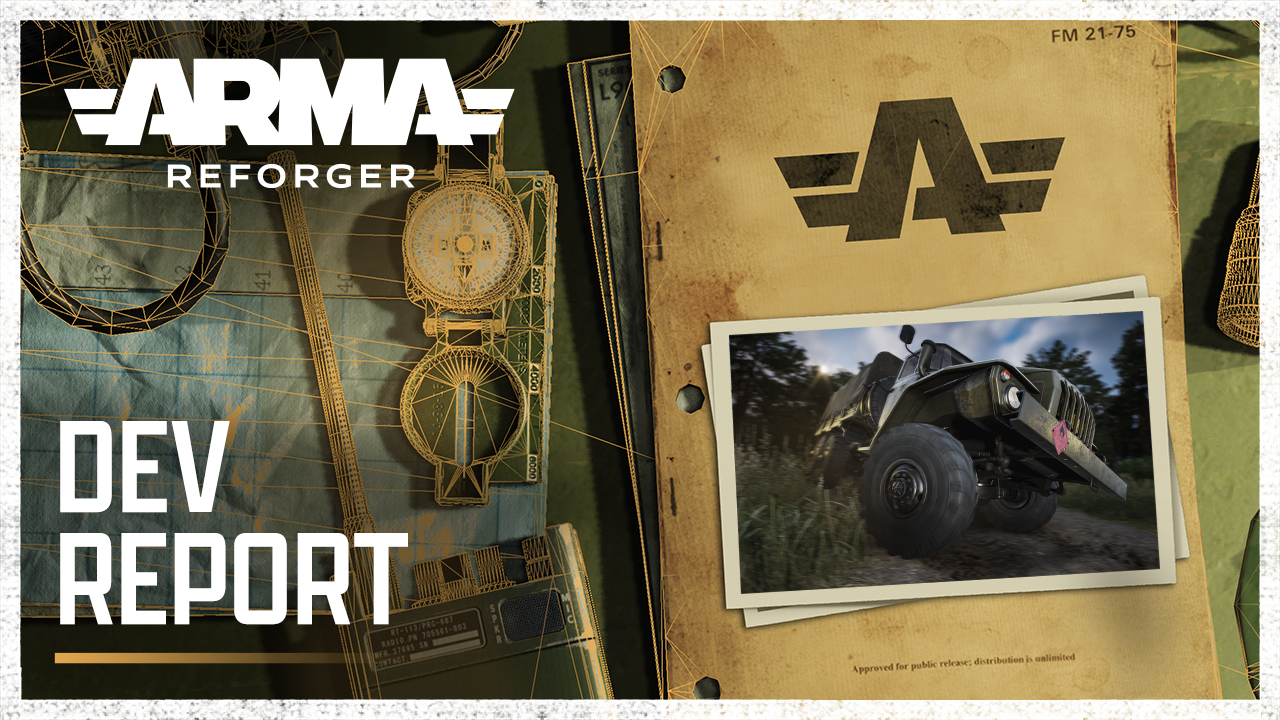
Development on Arma Reforger has continued to move forward, with plenty happening both in the main game and behind the scenes. With 1.8 already out and 1.9 now on Experimental, there is a lot to cover.
In this Dev Report, we’ll look at some of the work that has continued since 1.8, take a look at the major vehicle simulation changes coming with 1.9, and touch on what else is on the horizon for Arma Reforger.
INTELLIGENCE
Since our last Dev Report, we released the 1.8 Major Update across all platforms. But as always, releasing an update does not mean development stops. Since then, we have continued working through community feedback, fixing issues, and refining several of the systems introduced or changed in 1.8.
Our first follow-up update, 1.8.0.13, brought another round of stability, gameplay, vehicle, and modding fixes. This included improvements to Far Hide, helicopter damage, vehicle behavior, server performance, and several crashes and scripting issues.
That work has continued into the current 1.9 Experimental. AI visibility through vegetation has received further fixes, while stability, replication, server browser usability, Conflict balancing, supply handling, and other systems continue to be adjusted and improved.
Experimental also gives us an opportunity to iterate quickly on larger changes. Since the first 1.9 build, we've made additional adjustments based on testing and feedback, particularly around vehicle handling and input controls.
Though there is always more to fix and refine, we appreciate everyone continuing to test the Experimental builds and report issues through the Feedback Tracker.
And speaking of vehicles...
OPERATIONS
That brings us to vehicle simulation, which has continued to evolve significantly in 1.9. Beyond addressing existing issues, this work introduces new features and expands what the system can do... and there is a lot to go over.
Vehicle Simulation
The most notable change in vehicle simulation is a complete overhaul of the entire powertrain simulation. The simulation of all powertrain components (engine, clutch, differential, wheels) has been rewritten from scratch, while maintaining backward compatibility with the previous implementation.
Although the wheel simulation was already fixed in 1.7, the incorrect powertrain simulation unfortunately caused more issues than it solved. One of the most notorious issues was that some vehicles (trucks in particular) had become very slow on hills or couldn't move at all. This was due to incorrect torque flow from the wheels to the engine, which would cause the engine RPM to rise suddenly all the way up to redline, which can be a really weak zone in most diesel engines. We temporarily addressed this in 1.7 and 1.8 versions by expanding the engine power zone in the M923A1 and Ural trucks. This, however, made them too powerful on flat surfaces. The new powertrain simulation fixes many of these problems, including incorrect torque flow, slipping parts, and sometimes torque appearing randomly out of nowhere.
Another important change is that the Pacejka tire model can be tweaked for each vehicle, thus allowing each vehicle to have a unique tire friction behavior. In addition, it is possible for a tire to have different behavior on-road vs. off-road.
Wheels, Steering, and Suspension
Previously, the wheel axis was always perpendicular, and the wheel, steering, and suspension axes were identical. As of 1.9, you can define them independently, which lets us simulate the wheel more accurately (Caster, Camber, Toe, and SAI), and we can now simulate steering torque feedback, which wasn't possible before. Thanks to this feature, you might notice that while steering a stationary vehicle, one side can dip up or down, due to what is typically referred to as Wheel Jacking (because it's as if the wheels are jacking up the car).
In addition, vehicles now use Ackermann steering. While turning, the wheel away from the turn should rotate less than the inner wheel. Previously, the lack of this feature made vehicles slow down significantly during turns due to excessive friction.
Thanks to the new steering torque feature, vehicles without a driver (or an unconscious/dead driver) will now steer themselves as they move. For example, a car on a slope will steer into the slope. This will also make them less predictable and more dangerous, which is all the more reason to always engage the handbrake before leaving the vehicle!
We now also support ABS braking, which prevents wheels from locking up during braking and thus being unable to steer properly. This feature isn't currently used in vanilla vehicles, but the modding community can use it.
Central/Inter-axle Differentials (IADs)
Until now, in vehicles that have more than one drive axle, the gearbox torque was divided between them using a "torque share" parameter (usually equally). This meant that, for example, in a truck with three drive axles, if the middle axle was in the air, it would waste 33% of the torque, which usually meant it couldn't move anymore at all.
All such vehicles now use inter-axle differentials, which properly distribute the torque among them based on their traction. This will make many vehicles, especially those with more than two axles, such as trucks and APCs, more powerful on uneven terrain.
In Arma Reforger, we currently don't support manual differential locking/unlocking. Therefore, all IADs are either always locked or simulated in LSD mode. In real life, IADs are typically only locked manually, because they can cause too much stress on the drivetrain, especially if all wheels have high traction (e.g. on asphalt). But this is not a problem in our simulation as we don't model powertrain damage (yet).
Clutch
Under the old system, we also didn't simulate the clutch correctly. It was almost always slipping, and its only purpose in the simulation was disengaging the engine from the rest of the drivetrain.
We now simulate the clutch correctly. It can properly transfer torque to/from the engine, and it can also stall the engine. In manual cars, if you leave the car without putting it in neutral (in Partial/None driving assistance modes), the engine will stall, and the car will jolt a bit.
Engine
Besides stalling the engine, it also simulates it while it is stalled/off. Previously, vehicles that were turned off could move freely in gear without any resistance. Now the engine's compression can slow them down significantly. This means, for example, if you leave a car without engaging the handbrake, but in 1st or R gear, it might not move or move very slowly.
Visual Effects
Dust and Mud
Vehicles can now get dirty with dust or mud depending on the environment, and they can get cleaned by rain or wading through water. While moving through water might clean the vehicle at first, moving onto dusty terrain afterward will make the vehicle muddy.
Skid Marks
All vehicles can leave skid marks as they slip on surfaces. You can also have "static skid marks" without any slipping, such as when moving on dirty or muddy surfaces. While this feature was not enabled for all vehicles for performance reasons, it can be enabled by scenario designers and modders.
Tire Smoke/Burnout
When tires slip too fast and get too hot from friction, they can start to smoke.
Input and Controls
Full Racing Wheel and Force Feedback Support
We now support the entire racing wheel, pedals (gas, brake, clutch), and shifting sticks. We also support realistic force feedback (FFB) as provided by the simulation, without using any vendor-specific FFB features. Currently, we use the following FFB effects: Steering torque, clutch slip, gear grind, engine vibration, and suspension vibration.
How the shifting stick works depends on the Driving Assistance Mode in gameplay options. If set to Full, they don't do anything. If set to Partial, all vehicles are driven like an automatic (i.e. only R/N/D modes). If set to None, cars with manual transmission can fully use the stick.
To use the clutch, you must do all of these:
Use None driving assistance.
In gameplay options, turn on the Manual clutch option.
In game options, either select a preset or use the keybinding UI to bind the clutch action manually. You can also use it with a gamepad or keyboard, but it's not recommended.
Note that the car itself must have a manual transmission to be able to control the clutch manually.
When using a manual clutch, you can shift gears freely. But if you release the clutch improperly, you will notice a strong gear grind force feedback.
Mouse Steering
If you prefer mouse and keyboard but still want an analog experience, we recommend trying the new mouse steering feature. By default, the mouse is bound to the steering actions.
You can tweak the mouse steering speed in gameplay options.
Unified Steering Speed Across Devices
Previously, analog controls could steer the vehicle instantly, which gave users with controllers an unfair advantage and sometimes even worked to their disadvantage, as instant steering could flip vehicles at high speeds.
Now all vehicles have their own maximum steering speed (limited based on their physical characteristics and human abilities). In addition, releasing the controls doesn't center the steering wheel immediately; instead, it uses natural centering to prevent sudden wheel slipping.
Faster Gear Shifting from Reverse to Drive/1st
On controllers and keyboard, when using None or Partial driving assistance modes, you can hold the Gear Shift Up key (E on keyboard, left stick up on controllers), to switch to the 1st gear (if manual and None assistance) or D (if automatic/Partial assistance).
Similarly, you can hold the Gear Shift Down key (Q on keyboard, left stick down on controllers) to switch to Reverse (this feature was already present).
You can change or remove the keys in Game options → Controls → Vehicle → Gear 1/Reverse
Of course, there is still more to tune as 1.9 moves toward release and beyond. These changes are intended not only to address current vehicle issues, but also to provide a stronger, more flexible foundation for future development. Just as importantly, the expanded simulation and configuration options should give modders more control over how vehicles can be built and behave.
LOGISTICS
Earlier this month, we also revealed the upcoming Arma Reforger Rally DLC, which feels particularly fitting alongside all of the vehicle simulation work discussed above. Rally will put much more emphasis on getting behind the wheel, and we hope the improvements coming with 1.9 will help make that experience even more enjoyable. If you haven't already, you can check out the DLC and add it to your wishlist now on Steam or Xbox.
Wishlist Rally DLC now on Steam! 👇https://t.co/g3DLZC0heT
— Arma Platform (@ArmaPlatform) September 9, 2026
The reveal was also a special one for us, taking place as part of Rally Point Praha with a group of community members and content creators who joined us here in the Czech Republic. A big thank you to everyone who made the trip, took part in the event, and helped us reveal Rally to the wider community.
As always, stay tuned to our official channels for the latest updates, sneak peeks, and news as we continue to develop and improve Arma Reforger.
Until next time... We’ll see you on the battlefield!